
Press Release: 5th October 2026
Turning complex carbon accounting requirements into clear, defensible answers
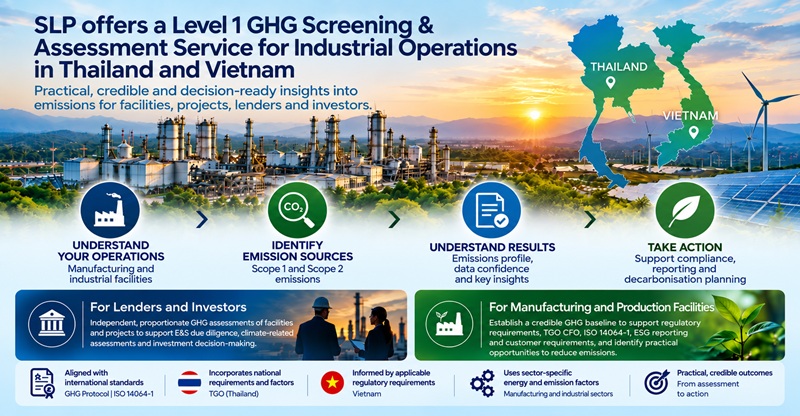
SLP Environmental has launched a new GHG Emissions Assessment & Inventory Service designed to help manufacturing and production facilities in Thailand and Vietnam understand and quantify their greenhouse gas emissions, while also supporting developers, lenders, investors and financial institutions requiring GHG assessments of projects under development or existing operations.
With increasing regulatory, investor, customer and supply-chain pressure to understand and disclose carbon emissions, many organisations are asking a deceptively simple question:
“How much GHG are we actually emitting — and can we demonstrate how we arrived at the number?”
SLP’s new service provides a practical answer.
A sophisticated methodology made simple
SLP has developed a proprietary Level 1 GHG Screening & Assessment Tool that enables experienced assessors to systematically identify and quantify material Scope 1 and Scope 2 GHG emissions associated with a facility or project.
The tool combines controlled emission factors, recognised GHG accounting principles, sector-specific energy benchmarks and country-specific information for Thailand and Vietnam and is designed to accommodate a broad range of manufacturing and production activities.
Designed for a broad range of manufacturing and production industry sectors
The Level 1 methodology is designed for a broad range of manufacturing and production facilities, including food and beverage, plastics and packaging, consumer products, electronics and electrical equipment, automotive and component manufacturing, textiles and apparel, chemicals, pharmaceuticals, building materials and other general industrial operations. The methodology can also accommodate facilities with more specialised processes, energy sources or emission pathways, with SLP determining the appropriate assessment approach based on the facility’s activities, scale and complexity.
It considers, as applicable:
- Direct fuel combustion and other Scope 1 sources;
- Purchased electricity and other Scope 2 energy sources;
- Process emissions;
- Refrigerants and other fugitive emissions;
- Biomass and renewable energy;
- Country-specific emission factors;
- Sector and process energy-intensity benchmarks;
- Production volumes and technology/process characteristics; and
- The quality, completeness and confidence of the underlying data.
The methodology draws on recognised international GHG accounting principles and good international industry practice, together with relevant national information and benchmarks, including TGO methodologies and emission factors in Thailand and applicable Vietnamese regulatory and national GHG information.
Importantly, SLP does not treat every estimate as equally reliable. The assessment distinguishes between actual measured data, project-specific estimates, benchmark-based estimates and data gaps, allowing clients and lenders to understand not only the reported emissions, but also how robust the underlying numbers are.
Supporting two important markets
- Manufacturing and Production Facilities
The service is particularly suited to individual manufacturing and production facilities that are taking their first structured step towards GHG accounting — for example, in response to customer or supply-chain requirements, ESG and sustainability initiatives, investor expectations or anticipated future regulation.
In Thailand, designated factories are subject to energy management and reporting requirements under the Energy Conservation Promotion Act B.E. 2535 (1992), as amended. In Vietnam, certain establishments are required under the Law on Environmental Protection No. 72/2020/QH14 and Decree No. 06/2022/ND-CP, as amended, to conduct and report greenhouse gas (GHG) inventories. SLP’s Level 1 GHG Screening & Assessment Tool provides a practical starting point for manufacturing and production facilities to estimate their Scope 1 and Scope 2 emissions, identify data gaps and understand whether a more detailed GHG assessment or inventory may be needed to meet applicable regulatory, customer and ESG reporting requirements.
The Level 1 assessment provides a practical starting point for facilities that may not yet have a formal GHG accounting programme. It establishes a credible baseline and identifies what needs to be improved before progressing to more detailed inventory, verification or carbon-reduction work.
SLP can support facilities responding to:
- Regulatory GHG inventory requirements;
- TGO Carbon Footprint for Organization (CFO) programmes in Thailand;
- ISO 14064-1 and related GHG inventory initiatives;
- Corporate sustainability and ESG reporting;
- Customer and supply-chain carbon disclosure requirements;
- Investor and financing requirements; and
- Internal carbon-reduction and decarbonisation programmes.
The Level 1 service is designed around an individual facility rather than a company-wide corporate inventory. Where a company requires GHG accounting across multiple facilities, head offices, warehouses, distribution activities or other organisational operations, SLP can develop a separately scoped corporate GHG assessment appropriate to its reporting requirements.
- Projects under Development, Lenders and Investors
For projects under development, SLP can provide an initial estimate of anticipated Scope 1 and Scope 2 GHG emissions based on the project’s development stage, proposed activities, energy sources, production characteristics and other available information.
This can support developers, lenders and investors undertaking:
- E&S due diligence;
- Climate-related assessments;
- Project financing and investment reviews;
- Early-stage GHG estimation; and
- Determination of whether more detailed GHG accounting or specialist assessment is warranted.
For lenders and investors, the assessment can identify:
- Principal GHG emission sources;
- Estimated annual Scope 1 and Scope 2 emissions;
- Material process emissions;
- Data gaps and areas of uncertainty;
- Emissions intensity and relevant sector benchmarks;
- Potentially material climate-related issues; and
- Whether more detailed GHG assessment or specialist work is warranted.
This provides a transparent, evidence-based GHG assessment without automatically turning every due diligence assignment into a full carbon-accounting exercise.
More than just a number
A GHG assessment should not simply produce a figure labelled “tCO₂e”.
SLP’s approach also identifies where the emissions come from, how they were calculated and how confident we can be in the result.
The outcome can therefore provide:
- A GHG baseline — a quantified picture of Scope 1 and Scope 2 emissions;
- A source profile — identification of the principal sources driving emissions;
- A data-quality assessment — distinguishing actual data, estimates, benchmarks and information gaps;
- A materiality assessment — identifying which data gaps actually matter;
- A practical improvement plan — recommendations for improving data collection and future reporting; and
- A pathway to more detailed assessment — where ISO 14064-1 inventories, verification, carbon-footprint certification, decarbonisation planning or other specialist services may be appropriate.
Internationally informed. Locally relevant. Proportionate to the Facility or Project.
SLP’s experience across Southeast Asia allows the methodology to incorporate local regulatory requirements, national emission factors and sector-specific information, rather than relying exclusively on generic international assumptions. The controlled database currently covers a range of manufacturing sectors and energy sources and is designed to be progressively expanded as new regulatory requirements, national factors and credible sector benchmarks become available.
From Assessment to Action
SLP’s GHG Emissions Assessment service is designed as a practical starting point — not an end in itself.
Following the initial assessment, SLP can support clients with more detailed GHG inventories and carbon accounting, climate risk and vulnerability assessments, GHG reduction and decarbonisation planning, climate-related due diligence and other climate services, with the appropriate methodology and level of assessment tailored to each client’s requirements.
For lenders and investors, the assessment can be integrated into broader E&S due diligence and climate-risk assignments.
For manufacturing and production facilities, it provides a practical foundation for establishing a credible GHG management and decarbonisation programme.
If you would like a proposal then please complete the contact us form or email us at info@slpenvironmental.com